With enabling the APRS digpeater on board of BOTAN satellite I was looking for a solution to work this bird in AFSK1200 aka. 1k2 packet radio mode. The initial setup was Greencube Terminal by OZ9AAR (see [1]) in combination with UZ0HO sound modem (see [2]). Radio hardware was an ICOM IC-9700 connected to a 4el. part of an Alaskan arrow antenna with only the 2m elements fitted. The setup was easy and got the station up and running in no time even with automatic doppler correction. But for some undiscovered reason the TX-side gave me issues and I never made a single packet in from this setup.
So the next try was using the Kenwood TH-D72 barefoot with the arrow antenna. Surprisingly this worked out of the box and I could get some packets digipeated at 5 watts. Also a position report got in and digipeated with this setup. The drawback here is that message handling on the D72 uses UI-frames with ACKs which the QSO partner does not send. So messages get repeated over and over again. This needs some further analysis if for example the retry-timer can be deactivated or set to no re-transmissions.
For that reason the next thing to try was a Linux system with the D72 connected via USB. As software I used a simple Python application called PyttiAPRS by IU1BOT (see [3]). This is very easy to setup but needs a KISS/TCP connection to the TNC which is just directly connected on a USB-serial interface in this case.
Luckily there is software around for all these cases and so I found two useful tools. The first one tmd710_tncsetup is a simple setup tool to configure TNCs of Kenwood radios. This also works for the built-in TNC of the TH-D72. Just needs to be called before using the TNC:
$ tmd710_tncsetup -B 0 -S /dev/ttyUSB0 -i -b 1200 -s -m 1This sets all parameters so that 1k2 AFSK packet radio can be used on the air interface. The next part was a little trickier: Making the TNC and its KISS interface available on a TCP port. After a while of research I found a tool called share-tnc by VA3TSK (see [4]). This tool makes TNCs available via TCP/IP and you can basically use a TNC via network. In this use-case the TNC is connected locally but nonetheless we can use a TCP connection via localhost. Running the program is as easy as:
$ share-tnc /dev/ttyUSB0 8001 --baud 9600Now you should be able to connect the TNC via the TCP port 8100. This is now configured in PyttiAPRS so that it can connect the TNC.
The drawback with this setup is that we have no control over when a packet is actually sent. In case the squelch is not closed it is pure chance when a packet is sent. Closing the squelch makes it harder to align prolarization during incoming packets and you will be missing some which are not strong enough to open the squelch continously. But with a closed squelch the TNC would send the packet right aber no signal is detected.
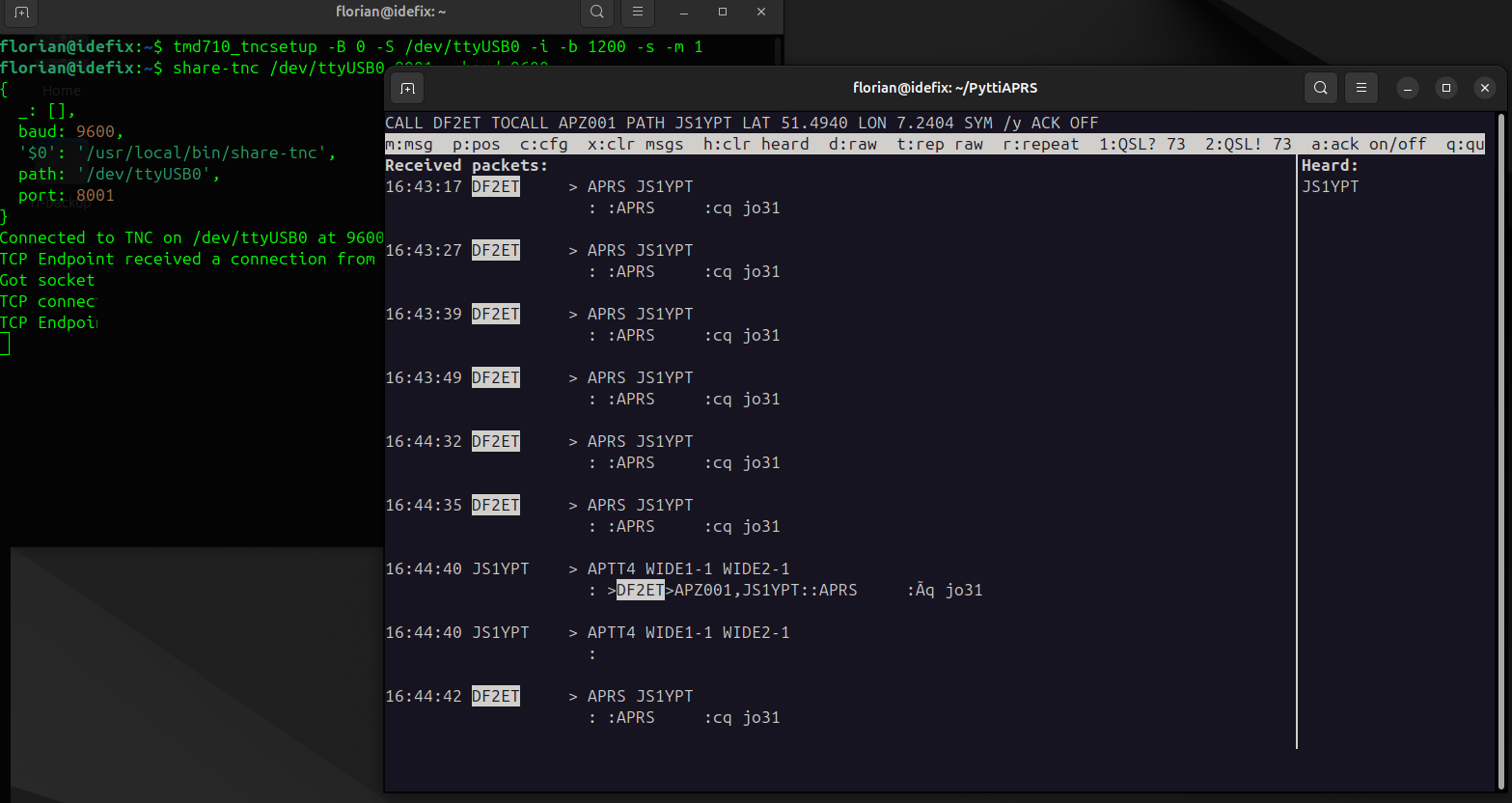
This setup was used for some packet radio QSOs in early January 2026. Still looking on how to improve this setup though and as to why the IC-9700 does not work (as also reported by other hams). In the meantime the author extended the software to directly support locally connected serial KISS TNCs. But the issue regarding squelch remains. Further tests and experiments needed.
References
[1]: https://moonbounce.dk/hamradio/greencube-terminal-program
[2]: https://uz7.ho.ua/packetradio.htm
[3]: https://github.com/vash909/PyttiAPRS
[4]: https://github.com/trasukg/share-tnc